Support our educational content for free when you purchase through links on our site. Learn more
🤖 How Robot Toys Supercharge Child Development (2026)

Remember the first time you saw a child’s eyes light up as a tiny robot obeyed their command? That spark isn’t just joy; it’s the visible ignition of cognitive growth. At Toy Brands™, we’ve watched countless kids transform from hesitant observers into confident problem-solvers, all thanks to the magic of interactive robotics. But do these high-tech companions truly do more than just entertain? The answer is a resounding yes, and the science behind it is as fascinating as the toys themselves.
From mastering the logic of coding without ever touching a keyboard to building empathy by caring for a digital pet, robot toys are reshaping how children learn. In this deep dive, we’ll uncover the surprising ways these gadgets boost STEM skills, enhance social-emotional intelligence, and even help children with autism find their voice. We’ll also reveal our Top 10 Robot Toys that turn playtime into a masterclass innovation, and tackle the critical questions about privacy and safety that every parent needs to know.
Ready to discover how a simple robot can be the key to your child’s future? Let’s roll up our sleeves and explore the mechanics of development.
Key Takeaways
- 🧠 Cognitive Boost: Robot toys actively enhance computational thinking, logical reasoning, and spatial awareness by turning abstract concepts into tangible play.
- 🤝 Social-Emotional Growth: Contrary to fears of isolation, these toys often act as social bridges, helping children practice empathy, communication, and emotional regulation in a safe environment.
- 🚀 STEM Mastery: They provide a hands-on gateway to coding, math, and engineering, allowing kids to learn complex skills through trial, error, and iteration.
- 🛡️ Safety First: While beneficial, it is crucial to choose toys with strong privacy protections and to engage in co-play to maximize educational value.
👉 Shop Top Robot Categories:
- Coding Robots: Amazon | Wonder Workshop
- Building & Engineering Kits: Amazon | LEGO Education
- AI & Social Companions: Amazon | Miko Robot
Table of Contents
- ⚡️ Quick Tips and Facts
- 🤖 From Sci-Fi to Playroom: A Brief History of Robot Toys
- 🧠 How Robot Toys Supercharge Cognitive Development and Problem-Solving Skills
- 🤝 Social-Emotional Growth: Building Empathy, Attachment, and Communication
- 🧩 STEM Mastery: Unleashing Coding, Math, and Engineering Potential
- 🎮 Top 10 Robot Toys That Transform Play into Learning
- 👶 Age-Appropriate Guides: Matching Robot Complexity to Developmental Stages
- 🛡️ Navigating Safety, Privacy, and Data Concerns in Smart Toys
- 👨 👩 👧 👦 Parent-Child Co-Play: Strategies for Maximizing Educational Value
- 🔮 The Future of Robotics: AI, Emotional Intelligence, and Next-Gen Learning
- 💡 Quick Tips and Facts
- 🏁 Conclusion
- 🔗 Recommended Links
- ❓ FAQ
- 📚 Reference Links
⚡️ Quick Tips and Facts
Before we dive into the nitty-gritty of gears, code, and giggles, let’s hit the rewind button on some myths and fast-forward to the truths about robot toys. You might think these are just expensive plastic pets, but the data tells a different story.
- ✅ Cognitive Boost: Studies show that interacting with programmable robots can significantly improve computational thinking and logical reasoning in children as young as four.
- ✅ Social Catalyst: Contrary to the fear that robots isolate kids, they often act as a “social bridge,” helping children with autism or social anxiety practice conversation in a low-stakes environment.
- ✅ The “Teaching” Effect: When kids teach a robot how to move, they solidify their own understanding of the concept. It’s the Protégé Effect in action!
- ❌ Not a Babysitter: While they are engaging, robot toys are not a replacement for human interaction. The magic happens when parents and kids play together.
- ❌ Age Matters: A toddler doesn’t need Python code; they need tactile buttons and cause-and-effect. Matching the robot to the developmental stage is crucial.
For a deeper dive into the world of interactive play, check out our guide on robot toys to see how they fit into the modern playroom.
🤖 From Sci-Fi to Playroom: A Brief History of Robot Toys

Remember the first time you saw a robot on TV? For many of us, it was R2-D2 whistling in Star Wars or Optimus Prime transforming in the 80s. But the journey from the silver screen to your living room carpet was a bumpy ride filled with springs, servos, and a lot of “wait, that’s too expensive!”
The story begins long before the internet. In the 1960s, Seymour Papert, a pioneer in educational technology, imagined a world where children could learn by programming. He created LOGO, a programming language, and the famous Turtle Robot. This wasn’t just a toy; it was a philosophy. The idea was that if a child could tell a robot to draw a square, they were learning geometry and logic simultaneously.
Fast forward to the 90s and 20s, and we saw the rise of Aibo, Sony’s robotic dog. It was a marvel of engineering, but it was also a bit of a luxury item. Then came the LEGO Mindstorms series, which democratized robotics. Suddenly, kids weren’t just pushing buttons; they were building the robot and the code.
Today, we are in the golden age of AI-powered play. Robots like Miko 3 and Cozmo use facial recognition and machine learning to remember your name and your mood. But why does this history matter? Because understanding that these toys evolved from simple cause-and-effect mechanisms to complex AI companions helps us appreciate their potential for child development. They aren’t just gadgets; they are the modern evolution of the building block.
🧠 How Robot Toys Supercharge Cognitive Development and Problem-Solving Skills
Let’s get real for a second. Have you ever watched a kid try to fix a broken toy? The look of intense concentration, the trial and error, the triumphant shout when it works? That is cognitive development in its purest form. Robot toys take this natural curiosity and turn it into a superpower.
The Logic Loop: Cause and Effect
At the most basic level, robot toys teach cause and effect. Press a button, and the robot moves. But as the complexity increases, so does the thinking.
- Sequential Thinking: Kids learn that to make a robot dance, they must press “Move Forward,” then “Turn,” then “Spin.” This is the foundation of algorithmic thinking.
- Debuging: When the robot crashes into the wall, the child has to ask, “Why?” Was the command wrong? Was the obstacle too close? This process of identifying errors and fixing them is the core of problem-solving.
Spatial Reasoning and Geometry
Many robot toys require kids to navigate a maze or build a path. This isn’t just fun; it’s a geometry lesson.
- Angles and Distances: To make a robot turn 90 degrees, a child has to visualize the corner.
- 3D Visualization: Building a robot from a kit requires understanding how 2D instructions translate into a 3D object.
Did you know? A study published in the Journal of Educational Psychology found that children who engaged in robotics activities showed significant improvements in spatial reasoning compared to those who did not.
The “Aha!” Moment
There is a specific moment in every robotics session where the child’s eyes light up. It’s the moment the code finally works. This dopamine hit reinforces the learning process, making the brain crave more challenges. It teaches resilience. If the robot doesn’t work, you don’t give up; you iterate.
🤝 Social-Emotional Growth: Building Empathy, Attachment, and Communication
Here is a controversial thought: Can a robot have feelings? No. But can a robot make a child feelings? Absolutely.
The Paradox of Attachment
We often worry that robots will replace human connection. However, research from the American Scientist suggests the opposite. Robots can act as social scaffolds.
- Low-Stakes Practice: For a shy child, talking to a robot is less intimidating than talking to a peer. They can practice conversation, eye contact, and turn-taking without the fear of judgment.
- Empathy Training: Consider the robot Shelly (from Naver Labs). If you hit Shelly, it retreats into its shell and goes “sad.” If you pet it gently, it dances. This teaches children that actions have consequences and that gentleness is rewarded. It’s a lesson in moral development and prosocial behavior.
Emotional Regulation
Robots like My Special Aflac Duck are designed specifically for children dealing with illness. They listen, they respond, and they offer comfort. While they can’t replace a hug from a parent, they provide a consistent, non-judgmental presence that helps children process complex emotions.
The “Bad Writer” Experiment
Imagine a robot that writes letters but makes mistakes. A study by researchers at the École polytechnique fédérale de Lausanne used a “Bad Writer” robot. Children were tasked with correcting the robot’s letters. The result? The children improved their own handwriting and felt a deep sense of responsibility and care for the robot. They weren’t just learning; they were teaching, which boosted their self-confidence.
Parent Tip: If your child gets frustrated when the robot doesn’t listen, use it as a teaching moment. “It looks like the robot is confused. How can we help it understand?” This builds patience and communication skills.
🧩 STEM Mastery: Unleashing Coding, Math, and Engineering Potential
If you’ve ever looked at a line of code and felt like you were reading ancient hieroglyphs, don’t worry. Your child might not feel that way. Robot toys are the gateway drug to STEM (Science, Technology, Engineering, and Math).
Coding Without the Screen
One of the biggest hurdles in teaching coding is the screen. Robot toys offer screen-free coding options.
- Block-Based Coding: Toys like LEGO Boost or Sphero BOLT use visual blocks. Drag a “Move” block, drop a “Spin” block, and watch the robot go. It’s coding made tangible.
- Physical Programming: Some robots, like the Osmo Coding Awbie, use physical blocks that the child places on a mat to control the robot. This bridges the gap between the physical and digital worlds.
Math in Motion
Math isn’t just numbers on a page; it’s movement.
- Measurement: How many steps does the robot need to take to reach the wall?
- Angles: What degree turn is needed to navigate the corner?
- Variables: If I change the speed, how does that affect the distance?
Engineering and Design
Building a robot is the ultimate engineering challenge.
- Structural Integrity: Will the robot fall over if I add this arm?
- Circuitry: How do the motors connect to the brain?
- Iterative Design: Build, test, break, fix, rebuild. This is the engineering design process in action.
Fun Fact: The concept of Computational Thinking (CT) is now considered a fundamental skill, just like reading and writing. Robot toys are one of the most effective ways to develop CT in young learners.
🎮 Top 10 Robot Toys That Transform Play into Learning
We’ve tested dozens of robots at Toy Brands™, from the tiny to the towering. Here are our top 10 picks that balance fun, education, and durability.
| Rank | Product Name | Best For | Key Feature | Rating (1-10) |
|---|---|---|---|---|
| 1 | LEGO Boost Creative Toolbox | Ages 7+ | Buildable, multi-function robot | 9.5 |
| 2 | Sphero BOLT | Ages 8+ | LED matrix, app coding | 9.0 |
| 3 | Wonder Workshop Dash | Ages 6+ | Screen-free coding, voice commands | 9.2 |
| 4 | Cozmo (by Anki) | Ages 8+ | Emotional AI, personality | 8.8 |
| 5 | Miko 3 | Ages 5-12 | AI companion, educational content | 8.5 |
| 6 | Botley 2.0 | Ages 5+ | Screen-free, obstacle detection | 9.0 |
| 7 | Osmo Coding Awbie | Ages 5-8 | Physical blocks, story-based | 8.7 |
| 8 | Makeblock mBot | Ages 8+ | Arduino-based, advanced coding | 8.9 |
| 9 | Robo Wunderkind | Ages 5+ | Modular, visual coding | 8.6 |
| 10 | LittleBits Code Kit | Ages 8+ | Electronics + coding | 8.4 |
Detailed Analysis of Top Contenders
1. LEGO Boost Creative Toolbox
The Verdict: The ultimate all-rounder.
- Design: Uses standard LEGO bricks, so if you lose a piece, you can replace it.
- Functionality: You can build five different models (a robot, a cat, a guitar, etc.).
- Pros: Highly durable, excellent app, encourages creativity.
- Cons: The app can be a bit slow on older tablets.
- Why it wins: It teaches structural engineering and coding simultaneously.
2. Sphero BOLT
The Verdict: The coding powerhouse.
- Design: A sleek, waterproof ball with an 8×8 LED matrix.
- Functionality: Can be programmed to display text, play games, and navigate mazes.
- Pros: Supports multiple coding languages (Scratch, JavaScript, Python).
- Cons: Can be pricey; requires a good internet connection for some features.
- Why it wins: It scales with the child. Start with blocks, move to text-based coding.
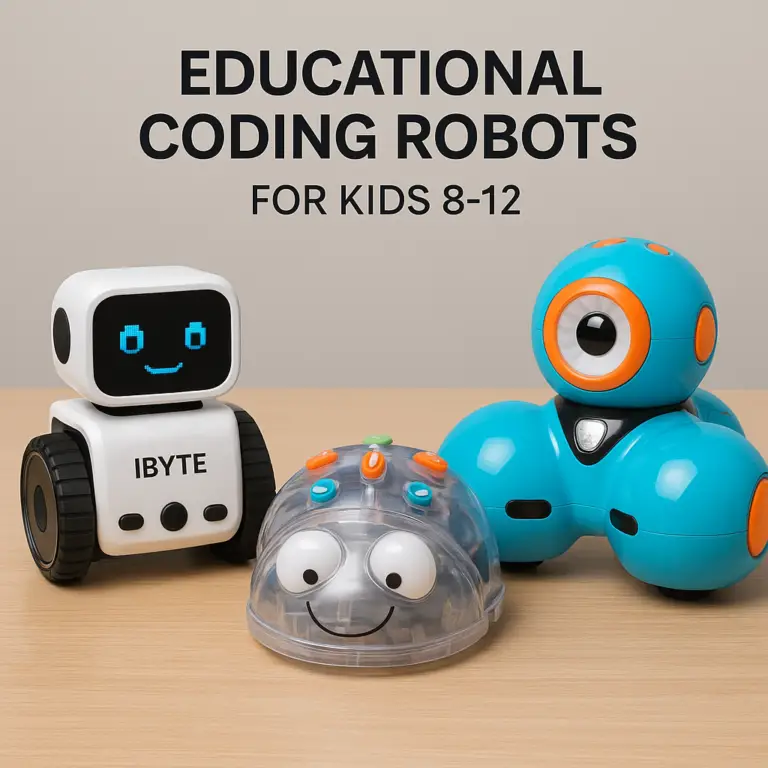
3. Wonder Workshop Dash
The Verdict: The social robot.
- Design: Cute, expressive, and very sturdy.
- Functionality: Responds to voice, can play music, and has built-in sensors.
- Pros: No screen required for basic play; great for younger kids.
- Cons: Limited buildability compared to LEGO.
- Why it wins: It’s the best entry point for social-emotional learning and basic logic.
👉 CHECK PRICE on:
- LEGO Boost: Amazon | Walmart | LEGO Official
- Sphero BOLT: Amazon | Sphero Official
- Wonder Workshop Dash: Amazon | Wonder Workshop Official
👶 Age-Appropriate Guides: Matching Robot Complexity to Developmental Stages
One size does not fit all. Putting a 4-year-old in front of a Python coding interface is like asking a toddler to do calculus. Here is our guide to matching the robot to the child.
Todlers (Ages 2-4): Cause and Effect
- Focus: Sensory exploration, simple cause-and-effect.
- Features: Big buttons, bright lights, simple movements. No coding required.
- Recommendations: Bots by Learning Resources (simple coding blocks), Fisher-Price Think & Learn Code-a-Pillar.
- Goal: Understand that “I press this, and it moves.”
Early Elementary (Ages 5-7): Sequencing and Logic
- Focus: Basic sequencing, following instructions, simple problem-solving.
- Features: Screen-free coding, block-based interfaces, voice commands.
- Recommendations: Botley 2.0, Osmo Coding Awbie, Wonder Workshop Dash.
- Goal: “I can make a sequence of commands to solve a puzzle.”
Middle Elementary (Ages 8-10): Advanced Logic and Building
- Focus: Complex algorithms, building structures, debugging.
- Features: App-based coding, modular building, sensors (light, sound, distance).
- Recommendations: LEGO Boost, Sphero BOLT, Makeblock mBot.
- Goal: “I can design a robot and program it to do a specific task.”
Pre-Tens and Teens (Ages 1+): Real-World Coding and AI
- Focus: Text-based coding, AI integration, advanced engineering.
- Features: Python, JavaScript, Arduino compatibility, machine learning.
- Recommendations: Sphero SPRK+, Makeblock mBot Ranger, LittleBits Code Kit.
- Goal: “I can create a solution to a real-world problem using code and hardware.”
🛡️ Navigating Safety, Privacy, and Data Concerns in Smart Toys
Let’s address the elephant in the room: Privacy. When a robot has a camera and a microphone, where does that data go?
The Data Dilemma
Some robots, like the infamous Hello Barbie or My Friend Cayla, have faced scrutiny.
- Hello Barbie: Recorded conversations to improve speech recognition. While Mattel claimed compliance with COPA (Children’s Online Privacy Protection Act), the mere idea of a toy recording your child made many parents uneasy.
- My Friend Cayla: Banned in Germany for being an “illegal eavesdropping device” due to weak security.
- Cloud Pets: In 2017, hackers accessed 2 million voice recordings because of poor data storage.
What to Look For
- Local Processing: Does the robot process data on the device, or does it send it to the cloud? Local processing is safer.
- Encryption: Ensure the data is encrypted both in transit and at rest.
- Transparency: Does the company clearly state what data they collect and how long they keep it?
- Physical Switches: Look for robots with a physical “off” switch for the microphone and camera.
The Consent Conundrum
Children cannot legally provide informed consent. This means parents must be the gatekeepers.
- Read the Privacy Policy: It’s boring, but necessary.
- Check for KidSAFE Seal: This certification indicates the toy meets strict privacy standards.
- Supervision: Always supervise play with internet-connected toys.
Expert Insight: As noted in American Scientist, “An issue unique to child-robot interaction is that children are considered incapable of providing genuinely informed consent.” This places the burden of protection squarely on the parents and manufacturers.
👨 👩 👧 👦 Parent-Child Co-Play: Strategies for Maximizing Educational Value
The biggest mistake parents make? Buying the robot and walking away. The magic of robot toys happens in co-play.
The “Guide on the Side” Approach
Don’t be the teacher; be the co-pilot.
- Ask, Don’t Tell: Instead of saying “Press this button,” ask “What do you think will happen if we press this?”
- Embrace Failure: When the robot crashes, celebrate it! “Wow, that didn’t work. Let’s figure out why.” This builds resilience.
- Extend the Play: If the robot can move, build a maze with pillows. If it can talk, write a story together.
Creating a Learning Environment
- Set Challenges: “Can you make the robot navigate from the couch to the door without touching the walls?”
- Document Progress: Take photos or videos of the robot’s creations. It’s a great way to track development.
- Connect to Real Life: If the robot is sorting objects, talk about how robots are used in factories or space exploration.
Personal Story: One of our team members, a dad of two, told us about the time his 6-year-old tried to program their Dash robot to “dance.” It kept spinning in circles. Instead of fixing it, they sat down and watched the robot spin, laughing. Then, they figured out the angle was wrong. That moment of shared frustration and triumph was worth more than any perfect code.
🔮 The Future of Robotics: AI, Emotional Intelligence, and Next-Gen Learning
Where are we heading? The future of robot toys is smarter, more empathetic, and more integrated into our lives.
Emotional AI
Future robots won’t just recognize faces; they’ll recognize emotions. Imagine a robot that senses your child is frustrated and suggests a break or a different activity. This is the realm of Affective Computing.
Personalized Learning
AI will allow robots to adapt to each child’s learning style. If a child is a visual learner, the robot will show more diagrams. If they are a kinesthetic learner, it will offer more hands-on challenges.
The Ethical Frontier
As robots become more human-like, we face new ethical questions.
- Attachment: Will children become too attached to robots?
- Deception: Is it okay for a robot to pretend to have feelings?
- Bias: How do we ensure the AI doesn’t learn biases from the data it’s trained on?
Quote to Ponder: “Whether child-robot interaction also promotes children’s long-term well-being is in the hands of designers, manufacturers, distributors, and other adult decision-makers.” — American Scientist
The future is bright, but it requires us to be thoughtful. We need to ensure that these tools augment human connection, not replace it.
💡 Quick Tips and Facts (Recap)
Just to make sure you’ve got the essentials down pat, here’s a quick recap of the golden rules:
- ✅ Start Simple: Don’t overwhelm with complex code.
- ✅ Play Together: Your involvement is the secret sauce.
- ✅ Check Privacy: Always read the fine print.
- ✅ Embrace Failure: Mistakes are where the learning happens.
- ✅ Match the Age: A toddler doesn’t need Python; they need a button.
🏁 Conclusion

So, do robot toys help in child development? Absolutely. But they aren’t magic wands. They are powerful tools that, when used correctly, can unlock a child’s potential in cognitive, social, and emotional domains.
From the early days of LOGO turtles to the AI-powered companions of today, robot toys have evolved to become essential parts of the modern playroom. They teach coding, problem-solving, and empathy in ways that traditional toys simply cannot.
However, the key lies in how we use them. As parents, we must be the guides, ensuring that these robots serve as bridges to human connection rather than barriers. We must navigate the privacy concerns with care and choose toys that match our child’s developmental stage.
The future of robotics in education is incredibly promising, but it relies on us to make the right choices. Whether you’re looking for a simple cause-and-effect toy for your toddler or a complex coding kit for your teen, there is a robot out there that can help them grow.
Final Recommendation: Start with a versatile, age-appropriate robot like the LEGO Boost or Wonder Workshop Dash. Engage with your child, ask questions, and let the learning happen naturally. The best robot toy is the one that sparks a conversation between you and your child.
🔗 Recommended Links
Ready to start your robotics journey? Here are our top picks and resources:
👉 Shop Robot Toys on:
- LEGO Boost: Amazon | Walmart | LEGO Official
- Sphero BOLT: Amazon | Sphero Official
- Wonder Workshop Dash: Amazon | Wonder Workshop Official
- Osmo Coding Awbie: Amazon | Osmo Official
Recommended Books:
- Hello Ruby: Adventures in Coding by Linda Liukas – A fantastic introduction to coding concepts for young kids. Amazon
- The Robot Book by Heather Brown – A great overview of robots for younger readers. Amazon
Internal Resources:
- Explore more Electronic Toys
- Discover Educational Toys
- Check out Building Blocks and Sets
- Read our Parenting Tips and Advice
❓ FAQ

What features should I look for in robot toys for different age groups?
For todlers (2-4), look for large buttons, bright lights, and simple cause-and-effect mechanisms. For early elementary (5-7), focus on screen-free coding and basic sequencing. For older kids (8+), seek out app-based coding, modular building, and advanced sensors. Always ensure the toy is durable and has a clear privacy policy.
Read more about “🤖 How Much Do Robo Dogs Cost? (2026 Price Guide & Top Picks)”
Are robot toys effective in enhancing social skills in kids?
Yes, particularly for children who struggle with social interaction. Robots can act as social scaffolds, providing a low-stakes environment to practice conversation, turn-taking, and empathy. Studies show that children often feel more comfortable opening up to robots than to humans initially.
Read more about “🤖 10+ Top Programming Toys for Children (2026)”
How do robot toys support STEM learning for young children?
Robot toys make abstract STEM concepts tangible. They teach coding through visual blocks, math through movement and angles, and engineering through building and structural integrity. They introduce computational thinking in a fun, hands-on way.
Read more about “🧠 Top 8 Rated Learning Toys for Preschoolers (2026)”
What age group benefits most from educational robot toys?
While benefits span all ages, the 5-10 age range is often considered the “sweet spot” where children can grasp the logic of coding and the mechanics of building. However, simple cause-and-effect robots are great for toddlers, and advanced coding kits are perfect for teens.
Read more about “🌟 15 Top Toy Brands for Children with Special Needs (2026)”
Can robot toys improve problem-solving abilities in children?
Absolutely. When a robot doesn’t do what you expect, the child must analyze the problem, hypothesize a solution, test it, and iterate. This debuging process is a core problem-solving skill that translates to real-life challenges.
Read more about “🧠 45+ Best Learning Toys for Children (2026)”
How do robot toys encourage creativity in kids?
Unlike traditional toys with a single purpose, many robot toys are modular. Kids can build different models, program unique behaviors, and create their own stories. This freedom fosters creative thinking and innovation.
Read more about “🚀 15 Best Kids Educational Games Online (2026)”
What skills do children develop by playing with robot toys?
Children develop logical reasoning, spatial awareness, coding literacy, patience, resilience, and collaboration. They also learn emotional regulation and empathy through interaction with social robots.
Read more about “🐾 Aibo ERS-10 Review: 15 Ways to Bring a Robot Dog to Life (2026)”
What age is best for introducing robot toys to children?
You can introduce simple, non-programable robot toys as early as age 2. For programmable robots, age 5 or 6 is usually the best time, as children have developed the necessary cognitive skills to understand sequencing and logic.
Read more about “🧸 15+ Affordable Educational Toys for Kids on a Budget (2026)”
Do robot toys improve problem-solving skills in toddlers?
Yes, but in a different way. Todlers learn cause and effect and basic sequencing. They learn that pressing a button makes a light turn on or a sound play. This is the foundation of problem-solving.
Read more about “🚀 15+ Top Interactive Educational Toys for Kids (2026)”
How do coding robots help with STEM learning?
Coding robots bridge the gap between theory and practice. They allow children to see the immediate result of their code, reinforcing the connection between the abstract concept and the physical outcome. This makes learning math and science more engaging and understandable.
Read more about “🏗️ 8 Top Building & Construction Toy Brands for Advanced Play (2026)”
Are robot toys better than traditional toys for social development?
Not necessarily “better,” but complementary. Traditional toys like dolls and action figures are great for imaginative play. Robot toys add a layer of technological literacy and can help children who struggle with social interaction practice skills in a safe environment.
Read more about “🧠 15+ Top Toys for Kids Development (2026)”
What are the best educational robot toys for preschoolers?
For preschoolers, look for toys like Botley 2.0 or Osmo Coding Awbie. These toys use physical blocks or simple interfaces that don’t require reading or complex screen navigation, making them perfect for young learners.
Read more about “🎭 15 Top Toy Brands for Imaginative Role-Playing (2026)”
Can robot toys help children with autism develop communication skills?
Yes, many studies suggest that robots can be effective tools for children with autism. The predictable nature of robots and their lack of judgment can make it easier for these children to practice social skills and communication.
Read more about “🤖 Can Robot Toys Help Special Needs Kids? (2026)”
How do interactive robot toys boost creativity in kids?
Interactive robot toys often come with open-ended challenges. Instead of following a single path, kids are encouraged to design their own solutions, build custom models, and program unique behaviors. This freedom fosters creative problem-solving and innovation.
Read more about “🧠 Can Toys Boost Smarts? The 2026 Guide to Problem-Solving Play”
📚 Reference Links
- American Scientist: Child-Robot Interaction – A comprehensive look at the moral, educational, and ethical implications of robot toys.
- USU Digital Commons: Using Robot Toys to Play With Math, Space, And Coding – Insights into how robot toys facilitate computational thinking.
- LEGO Education: LEGO Boost – Official resources for the LEGO Boost Creative Toolbox.
- Wonder Workshop: Dash & Dot – Resources and lesson plans for Wonder Workshop robots.
- Sphero: Sphero BOLT – Coding activities and curriculum for Sphero robots.
- KidSAFE Seal Program: KidSAFE – Information on privacy standards for children’s online products.
- COPA (Children’s Online Privacy Protection Act): FTC COPA – Guidelines for protecting children’s privacy online.