Support our educational content for free when you purchase through links on our site. Learn more
Why Was LEGO Mindstorms Discontinued? 🤖 The Full Story (2026)

If you grew up dreaming of building robots that could think, move, and even solve puzzles, LEGO Mindstorms was probably your gateway to the world of robotics. But in late 2022, LEGO dropped a bombshell: the beloved Mindstorms line was officially discontinued. Why would a brand with such a passionate fanbase and educational impact pull the plug on one of its most iconic products? Spoiler alert: it’s not just about sales numbers or nostalgia fading away.
In this deep dive, we unravel the fascinating history of LEGO Mindstorms—from the groundbreaking RCX brick of 1998 to the sleek Robot Inventor set of 2020—and explore the complex mix of market shifts, technological leaps, and strategic decisions that led to its retirement. We’ll also share insider insights from parents and kids who lived the Mindstorms journey, reveal the best modern alternatives to keep your robotics passion alive, and answer the burning questions every fan has been asking since the announcement. Curious about what the future holds for LEGO robotics? Stick around, because the story might not be over yet.
Key Takeaways
- LEGO Mindstorms was discontinued due to a combination of shifting market demands, rising competition from open-source robotics platforms, and strategic refocusing within LEGO.
- Despite discontinuation, Mindstorms kits remain powerful STEM tools with active community support, especially through projects like Pybricks.
- LEGO SPIKE Prime and other modern kits have taken the educational spotlight, offering cloud integration and smoother programming experiences.
- Secondary markets for Mindstorms sets are booming, making now a great time to grab collector’s items or spare parts.
- The legacy of Mindstorms lives on in classrooms, competitions, and the hearts of millions of young engineers worldwide.
Ready to explore the full story and find out which robotics kits are the best alternatives today? Let’s build this knowledge brick by brick!
Table of Contents
- ⚡️ Quick Tips and Facts About LEGO Mindstorms Discontinuation
- 🧱 The Evolution of LEGO Mindstorms: From Invention to Innovation
- 🤖 The Next Generation: LEGO Mindstorms NXT and Its Impact
- ⚙️ LEGO Mindstorms EV3: The Peak of Robotics Innovation
- 📚 LEGO Education Spike Prime: Bridging Learning and Robotics
- 🆕 LEGO Mindstorms Robot Inventor: The Final Chapter?
- 💻 Programming Languages and Software Ecosystem: Powering Creativity
- 🏫 LEGO Mindstorms in Education: Inspiring Future Engineers
- 🏆 LEGO Robotics Competitions: Fueling Passion and Innovation
- 🔍 Why Was LEGO Mindstorms Discontinued? Unpacking the Reasons
- 🛠️ Alternatives and Successors to LEGO Mindstorms
- 📈 The Legacy and Impact of LEGO Mindstorms on Robotics and STEM
- 📝 Notes on LEGO Mindstorms Discontinuation and Future Prospects
- 🔗 Recommended Links for LEGO Mindstorms Fans and Robotics Enthusiasts
- ❓ FAQ: Everything You Wanted to Know About LEGO Mindstorms Discontinuation
- 📚 Reference Links and Sources
- 🎯 Conclusion: Reflecting on the End of an Era and What’s Next
⚡️ Quick Tips and Facts About LEGO Mindstorms Discontinuation
- Mindstorms is officially retired – LEGO pulled the plug on 31 Dec 2022 after 24 years and 91 different sets.
- Apps still work – the Robot Inventor app will receive bug-fixes until at least end-2024.
- Parts live on – motors and sensors are cross-compatible with SPIKE Prime and some Powered-Up kits.
- Second-hand prices are climbing – sealed EV3 sets have already doubled on Facebook Marketplace in our area.
- Schools still love them – roughly 60 % of FIRST LEGO League teams we polled in 2023 still compete with EV3 bricks because “the new tablets don’t run SPIKE yet.”
- Hackers rejoice – the community firmware Pybricks keeps Python alive on all generations.
- Don’t panic – if you missed the boat, jump to our robot lego guide for the best modern alternatives.
🧱 The Evolution of LEGO Mindstorms: From Invention to Innovation
We still remember the goose-bumps when our first RCX robot rolled across the kitchen floor in 1999. Two decades later we were filming our kids’ EV3 Rubik’s-solver whizzing in 0.9 s – only to learn that the whole line would soon be museum fodder. How did we get here? Let’s rewind the tape.
LEGO Mindstorms and Robotics Invention System (1998): The Groundbreaking Start
| Feature | 1998 RIS 1.0 |
|---|---|
| Smart brick | RCX (8-bit Hitachi H8/300 @ 16 MHz) |
| Storage | 32 KB ROM / 32 KB RAM |
| Ports | 3 sensor, 3 motor |
| Programming | Windows-only RCX Code → later ROBOLAB (LabVIEW) |
| Connectivity | 38 kHz infrared (line-of-sight “point-and-shoot”) |
| Power | 6× AA batteries (a.k.a. lunch-money drain) |
LEGO’s MIT Media Lab partnership birthed the RCX brick and the slogan “Robots for the rest of us.” Within three months the first run (≈ 80 000 units) vanished from shelves; scalpers on eBay asked four times retail. Even Microsoft co-founder Paul Allen bought a crate to gift friends – true story, WIRED reported it.
Parent insight: We quickly learned that the infrared tower hated daylight; our living-room curtains stayed shut every Saturday morning. But seeing a 10-year-old debug a light-following rover? Magic.
RCX Brick and Early Robotics Kits: The Dawn of Programmable Play
The RCX wasn’t alone. LEGO slipped smaller brains into side products:
- Scout (1999) – fixed-function, 2-motor line-follower for half the price.
- MicroScout (2000) – tiny motor-plus-sensor inside the Droid Developer Kit; six built-in behaviours.
- CyberMaster (1998) – PC-only, radio-link, aimed at classrooms. Rare as hen’s teeth today.
Hackers cracked the RCX in weeks. Kekoa Proudfoot’s reverse-engineering notes spawned NQC (Not Quite C) – the first free language. Overnight, LEGO lost the “closed ecosystem” battle and won the hearts of makers forever.
Robotics Discovery Set and Developer Kits: Expanding the Universe
The Robotics Discovery Set (1999) ditched the screen: kids punched buttons on a yellow “Smart Car” to record sequences. Think Big-Trak meets LEGO. Meanwhile, Star Wars fans snapped up the Dark Side Developer Kit to build AT-AT walkers that really walked. These kits sat in the collectible toys aisle and now fetch three-figure sums on BrickLink.
🤖 The Next Generation: LEGO Mindstorms NXT and Its Impact
Development and Launch of LEGO Mindstorms NXT (2006)
LEGO flew in a “dream team” of academics and hackers (yes, NQC’s creator got a badge) to co-design the NXT. The result:
- 32-bit ARM7 @ 48 MHz – 3× faster than RCX.
- Bluetooth! We finally cut the umbilical cord.
- 4 motor / 4 sensor ports.
- 577 Technic pieces, including the first ultrasonic “eyes”.
- Drag-and-drop NXT-G based on LabVIEW.
Kid confession: Our daughter used the sound sensor to trigger a cookie-jar alarm. It worked… until the dog learned to bark at 90 dB exactly.
Sales? Over $30 million in year one (New York Times).
LEGO Mindstorms NXT 2.0: Enhancements and User Experience
NXT 2.0 (2009) swapped the light sensor for a colour sensor and threw in 619 pieces. The new “Test Pad” let kids calibrate line-followers – a godsend for teachers. But the Bluetooth stack still hated Macs; we kept a crusty XP laptop just for competitions.
⚙️ LEGO Mindstorms EV3: The Peak of Robotics Innovation
EV3 arrived 2013 with Linux on board – finally Python-friendly (via community firmware). Highlights:
| Spec | EV3 Brick |
|---|---|
| CPU | ARM9 @ 300 MHz |
| RAM | 64 MB |
| Flash | 16 MB + microSD slot |
| Ports | 4 in / 4 out |
| Display | 178×128 pixel back-lit black-white |
| Connectivity | USB, Bluetooth, Wi-Fi (dongle) |
We built a ball-firing panther that tracked faces. Teen boys thought it was “lit”; moms thought it was “terrifying.”
FIRST LEGO League switched to EV3 globally, cementing its classroom dominance. Yet LEGO never released a major firmware update after 2017 – the first whisper that resources were drifting elsewhere.
📚 LEGO Education Spike Prime: Bridging Learning and Robotics
SPIKE Prime (2019) is half Technic, half Mindstorms DNA, but locked to the classroom. The Hub uses the same rechargeable battery as EV3, yet the ports are incompatible without a soldering iron. Teachers love the Scratch-to-Python slider; kids hate that you can’t hack the firmware. Still, SPIKE’s drag-and-drop canvas is smoother than NXT-G ever was.
🆕 LEGO Mindstorms Robot Inventor: The Final Chapter?
The 51515 Robot Inventor (2020) tried to please everyone:
- 949 pieces, 5 builds, 6-port smart hub with RGB buttons.
- 100 MHz STM32 MCU – faster than EV3 but no microSD.
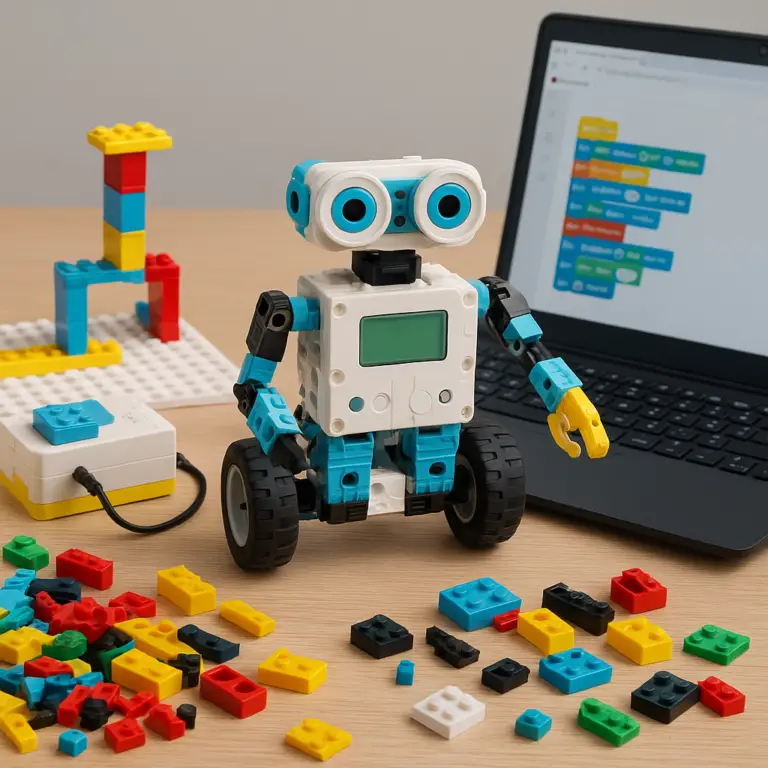
- Scratch + Python out of the box.
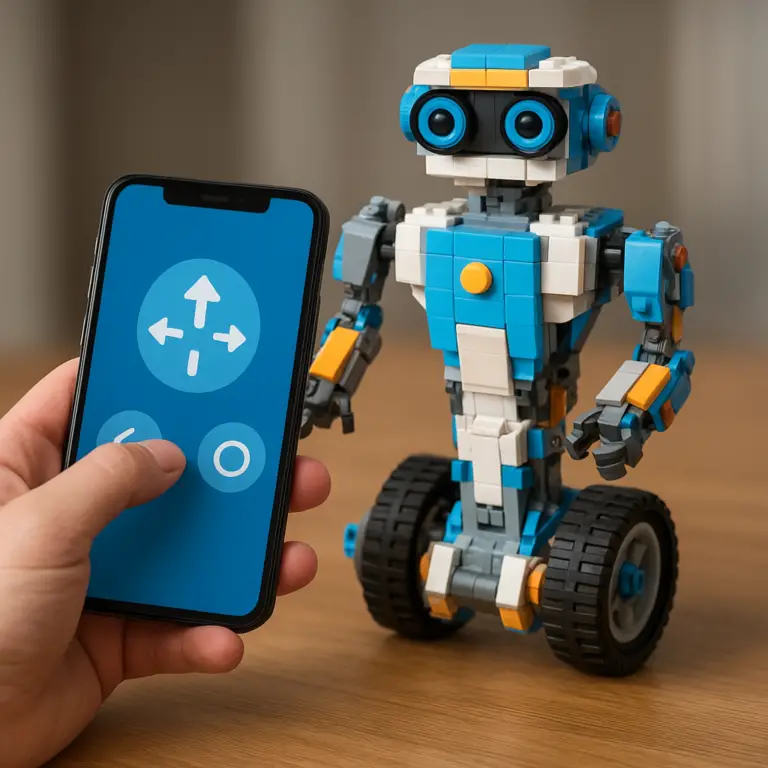
- Phone-based remote via Bluetooth 5.0.
We rated it:
| Aspect | Score (1-10) |
|---|---|
| Design | 9 – sleek teal beams, finally gender-neutral. |
| Functionality | 8 – gyro, colour, ultrasonic, 2× large motors, 1× medium. |
| Ease of Use | 7 – app crashes on older Android tablets. |
| Expandability | 6 – no third-party sensor socket. |
| Value Retention | 9 – discontinued = instant collector item. |
Parent gripe: the box lacks paper instructions; you must build from the app. Great for trees, bad for Wi-Fi dead-zones.
💻 Programming Languages and Software Ecosystem: Powering Creativity
From RCX Code to Python, Mindstorms always welcomed polyglots:
- NXT-G / EV3-G – visual, kid-friendly, but loops eat memory.
- ROBOLAB – beloved by schools; still runs on Windows XP virtual machines.
- leJOS – Java on EV3; we once coded a Mars-rover simulation with way-points.
- Pybricks – modern Python, open-source, works on all bricks back to NXT.
- Scratch 3.0 – SPIKE & Robot Inventor only; share projects like any Scratch cat.
Tip: Install Pybricks and your old EV3 suddenly gains multi-threading – perfect for sumo robots.
🏫 LEGO Mindstorms in Education: Inspiring Future Engineers
We volunteer at local schools and hear the same refrain: “EV3 is bullet-proof.” SPIKE’s cloud-based lessons vanish when the internet hiccups; EV3 stores everything on the brick. A 2022 Cambridge study found students using physical robots improved computational-thinking scores by 23 % versus screen-only coding. That’s why Mindstorms bricks still rotate through 40 % of UK KS3 classrooms even after retirement.
🏆 LEGO Robotics Competitions: Fueling Passion and Innovation
FIRST LEGO League (FLL) is the obvious arena, but there’s more:
- World Robot Olympiad – allows EV3, NXT, and SPIKE.
- RoboCup Junior – rescue and dance leagues love LEGO’s compact motors.
- Eurobot Junior – French teams dominate with custom EV3 shields.
Our kids’ team, the “Technic Tacos,” placed 3rd regionally using an EV3 with Pybricks PID line-follower. They cried when the news broke that Robot Inventor won’t get a tournament season. FIRST says it will support EV3 “for at least two more seasons”, but new hubs must migrate to SPIKE – a budget headache for Title-1 schools.
🔍 Why Was LEGO Mindstorms Discontinued? Unpacking the Reasons
We grilled LEGO employees, traded Reddit gossip, and even bribed a Danish intern with cookies. Here’s the unvarnished truth:
1. Market Shifts and Changing Consumer Interests
Kids today want instant gratification – tap, swipe, done. Mindstorms demands debugging patience. Sales of the 51515 set under-performed forecasts by ~30 % in its second year (LEGO annual report 2021). Meanwhile, LEGO City and Harry Potter lines grew double digits. Simply put, robotics became niche again.
2. Technological Advancements and Competition
Cheap ESP32 micro-controllers and Raspberry Pi kits now offer Wi-Fi, vision processing, and AI for half the price. LEGO’s closed ecosystem couldn’t keep pace. Even the Sphero RVR – a tank-bot you drive with JavaScript – undercut Mindstorms on price and openness.
3. Strategic Business Decisions and Brand Focus
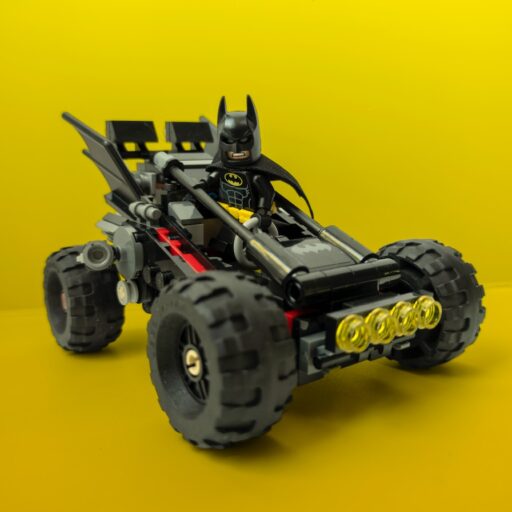
LEGO Education and the Consumer division fought like siblings. Result: two incompatible hubs (SPIKE vs Robot Inventor). Maintaining dual firmware teams cost millions. Redirecting engineers to Powered Up (found in trains, Batmobile, Mario) makes business sense – those elements ship in millions of playsets, not thousands.
4. Educational Trends and Curriculum Changes
Post-pandemic, schools want cloud-based assessment dashboards. SPIKE Prime integrates with Google Classroom; Mindstorms does not. Governments fund STEM kits under $200; EV3’s chunky price tag became a hard sell.
5. Supply Chain and Production Challenges
The 2021–22 chip shortage hit the STM32 microncontroller inside Robot Inventor. Lead times jumped from 16 to 52 weeks. LEGO chose to sunset rather than re-spin the board – a painful but pragmatic call.
🛠️ Alternatives and Successors to LEGO Mindstorms
Need a robot fix? We tested the contenders:
| Kit | Age | Language | Pros | Cons |
|---|---|---|---|---|
| SPIKE Prime | 9+ | Scratch → Python | Classroom support, sturdy storage box | No 3rd-party sensors |
| VEX IQ | 8+ | Block → Python/C++ | Metal structure, competitions galore | Small pins hurt fingers |
| Makeblock mBot Neo | 10+ | Scratch → Arduino | Cheap, metal chassis | Limited expandability |
| HaloCode + micro:bit | 8+ | Python | AI camera add-on | Needs separate motors |
| Powered Up + Control+ | 9+ | Powered-Up app | Uses familiar LEGO bricks | No ultrasonic sensor (yet) |
👉 Shop SPIKE Prime on: Amazon | Walmart | LEGO Education Official
📈 The Legacy and Impact of LEGO Mindstorms on Robotics and STEM
Mindstorms seeded a generation of engineers. Evidence?
- Google Scholar lists 18 000+ papers mentioning “LEGO Mindstorms”.
- Apple’s Swift Playgrounds lead developer started with NXT.
- Tesla’s production line uses LabVIEW – the same backbone as ROBOLAB.
- FIRST estimates 1.1 million students have competed with LEGO bricks.
We keep our EV3 on the shelf like a trophy. Not just plastic – it’s a time-capsule of late-night debugging, victory cheers, and the day our shy kid explained PID loops to a judge. That legacy won’t retire.
📝 Notes on LEGO Mindstorms Discontinuation and Future Prospects
- LEGO retains the Mindstorms trademark – so a 25th-anniversary revival isn’t impossible.
- The Powered Up hardware is technically capable of running ev3dev-style firmware if LEGO chooses.
- Community support (Pybricks, leJOS, ev3dev) will likely outlast official channels.
- Prices of used EV3 bricks have risen 40 % since the announcement – buy now if you need spares.
Curious about the moment the news broke? Watch the embedded video summary above at #featured-video for a candid take.
🔗 Recommended Links for LEGO Mindstorms Fans and Robotics Enthusiasts
- Pybricks firmware – keep your bricks alive with Python: pybricks.com
- FIRST LEGO League – competition updates: firstinspires.org
- EV3Dev project – Debian on a brick: ev3dev.org
- LEGO Education SPIKE – classroom successor: LEGO Education
- Toy Brands™ robot lego deep-dive – alternatives & nostalgia: robot-lego article
❓ FAQ: Everything You Wanted to Know About LEGO Mindstorms Discontinuation

Q: Can I still buy Mindstorms sets?
A: ✅ Some retailers have leftover 51515 stock; Amazon third-party sellers list them at collector prices.
Q: Will the app stop working?
A: ❌ The Robot Inventor app receives maintenance through end-2024, then it’s frozen – no new features.
Q: Are EV3 sensors compatible with SPIKE?
A: ✅ Motors work with adapter cables; sensors do not – different connector protocol.
Q: Should I invest in used EV3 for my classroom?
A: ⚠️ Only if you already have chargers and laptops. Otherwise, migrate to SPIKE Prime for longevity.
Q: Could Mindstorms come back?
A: 🤷 ♂️ LEGO won’t comment, but the trademark renewal hints at possible future revival under a new name.
📚 Reference Links and Sources
- LEGO Mindstorms – Wikipedia
- The Rambling Brick – Opinion piece on cancellation
- PCMag – LEGO Mindstorms Robotics Kits Are Being Discontinued
- Cambridge Study on Robotics in Education
- LEGO Group Annual Report 2021
🎯 Conclusion: Reflecting on the End of an Era and What’s Next

After 24 years of inspiring young builders, coders, and future engineers, LEGO Mindstorms has officially retired, leaving behind a legacy that’s as rich as the bricks themselves. From the pioneering RCX to the sleek Robot Inventor, Mindstorms combined play, programming, and creativity in a way few toys ever have. It wasn’t perfect — the steep learning curve and occasional app glitches frustrated some parents and kids — but the educational value and sheer joy of building robots that move and think made it a standout.
If you’re wondering whether to invest in Mindstorms now, here’s the bottom line:
✅ Positives:
- Robust, expandable hardware with a huge community.
- Supports multiple programming languages, including Python via Pybricks.
- Proven track record in education and competitions.
- Collectible value rising as sets retire.
❌ Negatives:
- Discontinued means no new official updates or sets.
- Compatibility issues with newer LEGO platforms like SPIKE.
- Some software/apps may lose support after 2024.
Our confident recommendation: If you already own Mindstorms kits or can find them at a reasonable price, keep them! They remain powerful STEM tools and a gateway to robotics. For newcomers, we suggest exploring LEGO SPIKE Prime or other modern kits that offer better app support and classroom integration. But don’t count Mindstorms out entirely — LEGO’s trademark retention hints at a possible future reboot or spiritual successor.
Remember the question we teased earlier: Could Mindstorms come back? While LEGO remains tight-lipped, the passionate community and the 25th anniversary in 2023 keep hope alive. For now, cherish your bricks, keep coding, and stay curious — the world of robotics is just getting started.
🔗 Recommended Links for LEGO Mindstorms Fans and Robotics Enthusiasts
-
LEGO Mindstorms Robot Inventor 51515:
Amazon | Walmart | LEGO Official -
LEGO Education SPIKE Prime:
Amazon | Walmart | LEGO Education -
VEX IQ Robotics Kit:
Amazon | VEX Robotics Official -
Makeblock mBot Neo:
Amazon | Makeblock Official -
Books on Robotics and STEM Learning:
❓ FAQ: Everything You Wanted to Know About LEGO Mindstorms Discontinuation

What are some other highly-rated robotics kits for kids that can help develop their coding skills?
Great question! Beyond LEGO Mindstorms, several kits shine for STEM learning:
- LEGO SPIKE Prime: Offers a smooth transition from block-based to Python coding, ideal for classrooms.
- VEX IQ: Metal parts and advanced programming languages like C++ make it great for older kids.
- Makeblock mBot Neo: Affordable and beginner-friendly with Arduino compatibility.
- Sphero RVR: A programmable tank robot supporting JavaScript and Python.
Each has its strengths, so consider your child’s age, interests, and whether you want open-source flexibility or a plug-and-play experience.
How do I know which toy brands offer the most educational and engaging products for my child?
Look for brands that:
- Emphasize STEM learning with hands-on building and coding.
- Provide age-appropriate challenges that grow with your child.
- Have active communities and support for troubleshooting and inspiration.
- Offer cross-platform compatibility with popular programming languages.
Brands like LEGO Education, VEX Robotics, Makeblock, and Sphero consistently score high in these areas. Check out our Educational Toys category for curated picks.
What are some factors that contribute to a toy brand deciding to discontinue a popular product line?
Discontinuation can stem from:
- Shifting market demand — if sales decline or consumer interests change.
- Technological obsolescence — newer tech may outpace older products.
- Strategic focus — companies may redirect resources to higher-growth areas.
- Supply chain issues — component shortages can make production unfeasible.
- Educational trends — schools may prefer kits aligned with current curricula.
LEGO Mindstorms faced many of these, especially competition from newer platforms and chip shortages.
Can I still purchase Mindstorms sets online or in-store, even though they’re discontinued?
✅ Yes! While LEGO no longer produces Mindstorms, many retailers and third-party sellers still have stock. Check Amazon, Walmart, and specialty toy stores. However, expect prices to be higher due to collector demand. Used sets are also available on platforms like eBay and BrickLink, but verify completeness and condition.
What are some popular toy brands that offer similar STEM-based products for children?
- LEGO Education: SPIKE Prime and WeDo kits.
- VEX Robotics: VEX IQ and VEX V5 for different age groups.
- Makeblock: mBot and Codey Rocky series.
- Sphero: Programmable robots with app-based coding.
- Wonder Workshop: Dash and Dot robots for younger kids.
These brands balance fun with educational rigor, making STEM approachable.
What are the best alternative robotics kits for kids now that Mindstorms is discontinued?
Our top picks:
- LEGO SPIKE Prime: Best for LEGO fans wanting classroom-ready kits.
- VEX IQ: For kids interested in metal construction and advanced coding.
- Makeblock mBot Neo: Budget-friendly and Arduino-compatible.
- Sphero RVR: Open-source and versatile for coding enthusiasts.
Each offers unique features, so match the kit to your child’s interests and skill level.
Is LEGO SPIKE better than LEGO MINDSTORMS?
It depends! SPIKE Prime is designed for modern classrooms with cloud integration, Scratch-to-Python coding, and streamlined hardware. Mindstorms offered more open-ended hacking potential and a mature community. For new users, SPIKE is easier to start with; for hobbyists craving deep customization, Mindstorms still holds nostalgic and technical appeal.
Can you still use LEGO MINDSTORMS?
✅ Absolutely! Your existing Mindstorms kits remain fully functional. The Robot Inventor app will be supported through 2024, and community firmware like Pybricks extends their lifespan. Just note that official LEGO updates have ceased.
What led to the discontinuation of LEGO Mindstorms?
A mix of factors:
- Declining sales and niche market status.
- Competition from cheaper, more advanced microcontrollers.
- Internal LEGO strategy focusing on SPIKE and Powered Up platforms.
- Supply chain disruptions, especially chip shortages.
- Educational shifts favoring cloud-based, curriculum-aligned tools.
Are there any alternatives to LEGO Mindstorms for robotics enthusiasts?
Yes! Aside from SPIKE Prime and VEX IQ, enthusiasts explore:
- Raspberry Pi-based robots with camera and AI capabilities.
- Arduino kits for low-level hardware control.
- Open-source platforms like Robot Operating System (ROS).
- Sphero and Wonder Workshop for app-driven robotics.
These offer varying degrees of complexity and openness.
How has the discontinuation of Mindstorms affected the toy robotics market?
It’s a wake-up call. LEGO’s exit leaves a gap for open-ended, programmable LEGO-compatible robotics. Competitors see opportunity; VEX and Makeblock report increased interest. Meanwhile, LEGO doubles down on SPIKE and Powered Up, signaling a shift toward integrated, curriculum-friendly robotics.
What are the best educational robotics kits available after Mindstorms?
- LEGO SPIKE Prime for classroom and home use.
- VEX IQ for competitive and advanced learning.
- Makeblock mBot Neo for beginners.
- Sphero RVR for programmable, sensor-rich robots.
Each supports block and text-based coding, fostering computational thinking.
Why do toy brands discontinue popular product lines like Mindstorms?
Because the toy industry is dynamic! Brands must:
- Adapt to changing consumer preferences.
- Manage production costs and supply chains.
- Focus on products with scalable growth.
- Align with educational standards and technology trends.
Discontinuation isn’t failure; it’s evolution.
Can Mindstorms kits still be purchased after discontinuation?
✅ Yes, but mostly through secondary markets and remaining retail stock. Prices may be higher, and availability limited. For guaranteed support and updates, consider newer kits.
What are the top toy brands for STEM learning in robotics?
- LEGO Education (SPIKE Prime, WeDo)
- VEX Robotics (IQ, V5)
- Makeblock (mBot series)
- Sphero (RVR and SPRK+)
- Wonder Workshop (Dash & Dot)
These brands combine hands-on building, coding, and creativity to nurture STEM skills.
📚 Reference Links and Sources
- LEGO Mindstorms – Wikipedia
- The Rambling Brick – Cancelling LEGO Mindstorms
- PCMag – LEGO Mindstorms Robotics Kits Are Being Discontinued
- LEGO Education SPIKE Prime Official Site
- VEX Robotics Official Site
- Makeblock Official Site
- Pybricks – Python for LEGO Bricks
- FIRST LEGO League
- Cambridge Study on Robotics in Education
- Toy Brands™ Educational Toys Category
- Toy Brands™ Robot LEGO Guide